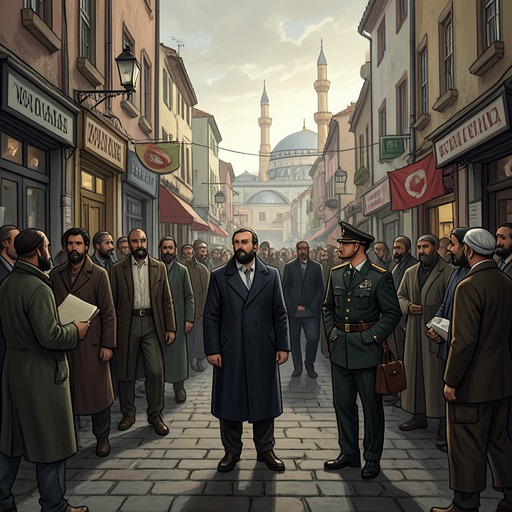
Mauritanian government
Guantanamo DiaryThe Mauritanian government is portrayed as a national authority whose police and security officials detained Mohamedou Ould Slahi repeatedly, first questioning him about the Millennium Plot and later transferring him to Jordan at the United States’ request. Its role changes from investigating and publicly releasing him to facilitating a secret transfer that the narrative presents as a breach of the country’s legal protections and sovereignty. The account also shows how the concealment of that transfer continued to affect Slahi’s family after he had left Mauritania.
Government and Security Apparatus
The government’s actions are conveyed through several layers of authority rather than through a single identifiable decision-maker. Police and security personnel carry out the arrests; Slahi’s account describes the president as receiving the United States’ request to hold him and directing the head of the national security service, who in turn orders personnel led by an inspector to detain him. The narrative makes clear that officials on the ground did not necessarily know the full purpose of the arrest. Slahi says that the inspector appeared to have little more information than he did, while the senior decision-makers were still conferring.
That division of knowledge matters to the account of the transfer. The police officer who first approaches Slahi in November 2001 asks him to come in for further questioning, and Slahi complies, driving his own car to the station. The later explanation of events presents this apparently ordinary request as the first visible step in a process whose destination was not a Mauritanian interrogation room but Jordan. In Slahi’s telling, responsibility passes upward through the security hierarchy and outward across national borders, while the person being detained is not told what is being arranged.
Detentions, Questioning, and Release
In January 2000, after twelve years studying, living, and working abroad, primarily in Germany and briefly in Canada, Slahi was returning to Mauritania. He was detained first by Senegalese police and then by Mauritanian authorities, and questioned by American Federal Bureau of Investigation agents about the alleged Millennium Plot to bomb Los Angeles International Airport. Authorities concluded there was no basis to believe he had participated and released him on February 19. This first episode establishes a pattern that later becomes important: questioning involved American agents, but Mauritanian officials retained the power to hold and release him within the country.
Slahi subsequently lived with his family and worked in Nouakchott as an electrical engineer, doing computer and electronics work. After the September 11 attacks, Mauritanian authorities detained him again on September 29, 2001, for roughly two weeks and questioned him once more with Federal Bureau of Investigation agents about the same plot. He was released in October, and the authorities publicly affirmed his innocence. According to the account, an intelligence official contacted Slahi’s employer to confirm that he could return to work. His employer did take him back, and Slahi continued his professional life rather than leaving the country.
The account emphasizes the contrast between these assurances and the next arrest. Shortly before the November detention, Slahi’s work had taken him to the Presidential Palace to prepare a bid to upgrade the president’s telephone and computer systems. When police came to his home again, they asked him to accompany them for questioning. He waited while they were there, took his keys, and went voluntarily in his own car. He told his mother he would be back soon. This time he did not return to the family’s knowledge, and the government’s earlier public statements of innocence did not prevent his removal from Mauritania.
November 2001: Detention and Transfer
Slahi spent seven days in Mauritanian custody before being told on November 28, 2001, that he would be sent to Jordan. His account presents the proposed transfer as a decision made under pressure from the United States, not as the conclusion of a Mauritanian criminal case. Mauritanian officials had sought incriminating information from Germany and Canada; Slahi says those countries provided reports attesting to his good conduct. He also maintains that the United States had not supplied evidence to justify his continued detention. These circumstances left the government facing a request to surrender one of its citizens without an evidentiary basis that Slahi considered sufficient.
In the narrator’s account, the president’s concern was not simply whether to detain Slahi but whether to send him to Jordan. Slahi describes that destination as a further affront to Mauritanian sovereignty, and the decision as politically risky for a president already vulnerable at home and under international criticism over the country’s human-rights record. The request also presented a legal problem: Slahi argues that the Mauritanian constitution prohibited extraditing Mauritanian citizens, and that he should instead have been tried under Mauritanian law if there were evidence against him. The article’s account presents this as Slahi’s legal and political judgment, not as a court ruling on the transfer.
The date sharpened the contradiction. November 28 was Mauritanian Independence Day, commemorating independence from French rule in 1960. The night before the transfer, guards allowed Slahi to watch a parade approaching the Presidential Palace, recalling that he had marched in it as a schoolboy. The following morning, security officials took him to an interrogation office. He was told that the trip to Jordan would be brief and that he might return within days, but no precise return date was available. A Central Intelligence Agency rendition plane transported him from Mauritania to a prison in Amman, where Jordanian intelligence services interrogated him for seven and a half months. The assurances of a short trip proved unreliable: the transfer began a longer sequence of detention that continued through Bagram Air Base and Guantánamo.
Concealment and Consequences for the Family
The government’s role did not end when Slahi left the country. For almost a year, his family was led to believe that he remained in Mauritanian custody. His older brother, Hamoud Ould Slahi, regularly visited the security prison to bring clean clothes and money for meals. According to the account, prison officials accepted the money while Slahi was elsewhere, and the family was not told that he had been transferred abroad. The false impression of a local detention therefore persisted alongside the cross-border transfer itself.
Slahi’s youngest brother, Yahdih Ould Slahi, learned what had happened on October 28, 2002, after reading in Der Spiegel that Slahi had been held for months at Guantánamo. The family’s anger was directed at the local authorities who had assured them that Slahi was in their custody and safe. The episode gives the government’s secrecy a concrete consequence: relatives continued to visit a prison and pay for a detainee’s upkeep without knowing that he was no longer there.
In the book’s wider account, the Mauritanian government is one link in an international chain of detention, but it is not depicted as a powerless bystander. Its officials arrested Slahi, controlled access to him, and enabled his departure to Jordan, while the United States set the broader course of the operation. The central tension is between the government’s earlier findings and public assurances that Slahi was innocent, and its later cooperation in transferring him without the evidence or legal process that, in Slahi’s view, should have been required. The Independence Day transfer brings that tension into focus: a state commemorating its sovereignty sends one of its own citizens abroad in a secret operation.